

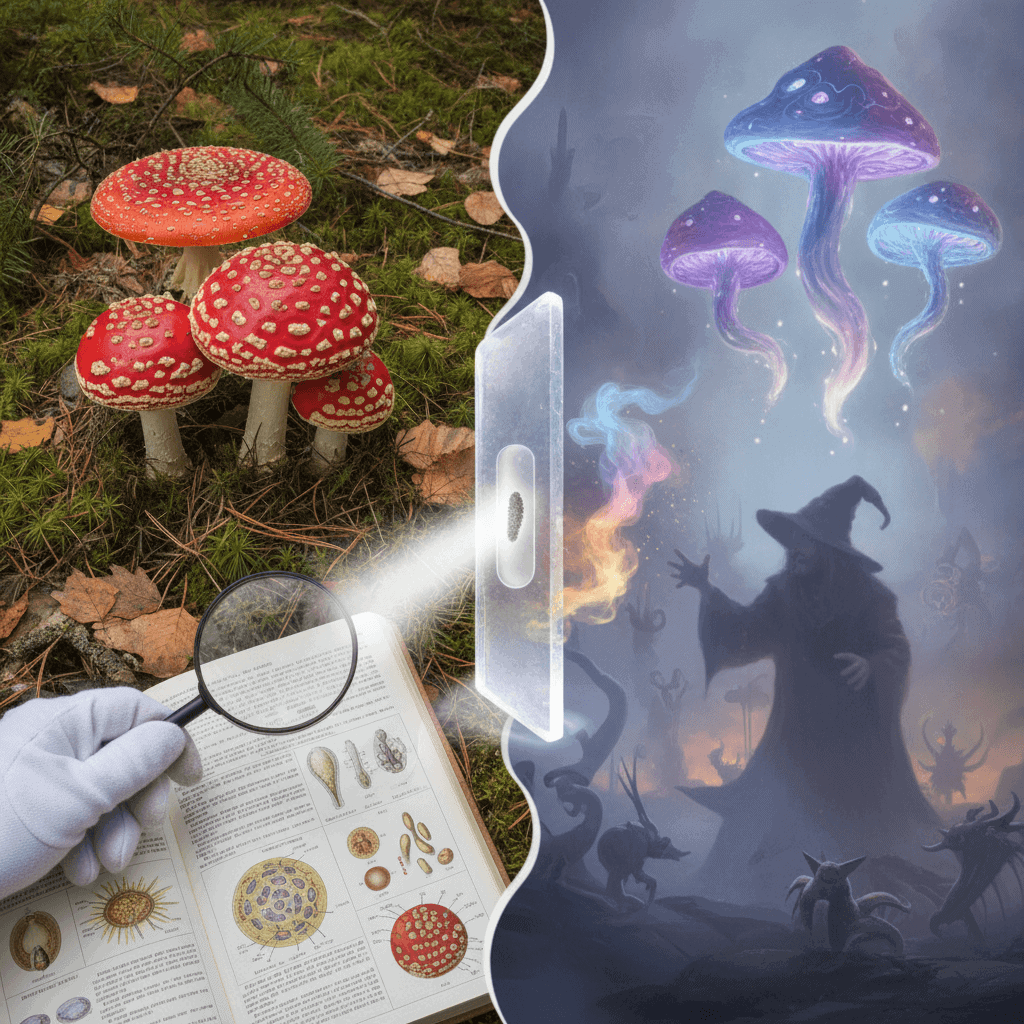
The Fly Agaric mushroom, with its striking red cap dotted with white flakes, holds a truly unique spot in both nature and human imagination. I have observed its presence in countless stories, artworks, and even video games, always sparking curiosity and a touch of mystery. For many years, this mushroom has been the subject of wild tales and serious scientific study.
People often encounter misleading ideas about the Fly Agaric, sometimes fearing it as deadly poisonous, and other times seeing it as a magical gateway. My aim today is to clear up some of those misunderstandings. We will look past the myths to find out what is truly known about this fascinating fungus.
Understanding the facts about Fly Agaric helps us appreciate its real place in ecosystems and cultures. I believe it is important to understand its chemical properties, historical uses, and ecological role. This knowledge allows us to see this mushroom not just as a symbol, but as a complex organism with its own story.
The Iconic Appearance of Amanita Muscaria
The Fly Agaric, scientifically named Amanita muscaria, is one of the most easily recognized mushrooms in the world. Its appearance is truly unforgettable. I have seen many illustrations of it showing a bright red or orange cap, often adorned with distinct white or yellowish spots. These spots are actually remnants of the universal veil that covered the mushroom when it was young.
Below the vibrant cap, you typically find white gills and a sturdy white stem. This stem often has a skirt-like ring around it and a bulbous base, which is also covered in rings or scales, another remnant of the universal veil. The entire structure makes it look almost like something out of a fairy tale, which is probably why it features so prominently in children’s stories and folklore.
I find it interesting that its appearance can vary quite a bit depending on where it grows. While the classic image is bright red, some varieties can be more orange, yellow, or even white. It grows widely across the Northern Hemisphere, showing up in coniferous and deciduous forests. It usually forms a symbiotic relationship with tree roots. I have noticed it especially thriving under birch, pine, and spruce trees.
This wide distribution and eye-catching look have certainly contributed to its global fame. People across many cultures have encountered it, leading to a rich collection of stories and beliefs about its powers. It is a mushroom that truly stands out in any forest setting.Understanding Fly Agaric’s Chemical Composition
The psychoactive properties of Fly Agaric come from a different set of compounds than those found in psilocybin mushrooms. I find this distinction very important for people to grasp. The main active compounds in Amanita muscaria are ibotenic acid and muscimol. These chemicals interact with the brain in ways quite distinct from psilocybin.
When someone consumes Fly Agaric, ibotenic acid acts as a neurotoxin. It causes a range of effects including nausea and disorientation. However, ibotenic acid also gets converted into muscimol in the body, primarily through decarboxylation, which is a process that removes a carboxyl group. This transformation makes the muscimol the more potent psychoactive agent.
Muscimol is a GABA agonist. This means it binds to gamma-aminobutyric acid receptors in the brain. GABA is the primary inhibitory neurotransmitter in the central nervous system. So, when muscimol activates these receptors, it essentially calms down brain activity. This can lead to sedative, dissociative, and sometimes delirious effects. I have learned that the experience can be very unpredictable and often quite different from the “hallucinogenic” effects associated with psilocybin.
The balance of ibotenic acid and muscimol, and how efficiently the body converts one to the other, largely dictates the exact nature and intensity of the experience. This chemical profile makes the Fly Agaric a subject of serious caution and scientific study.
Ibotenic Acid and Muscimol Conversion
Ibotenic acid and muscimol work together to create the effects of Fly Agaric. Freshly picked mushrooms contain more ibotenic acid. As the mushroom dries, or when it is heated during preparation, a good portion of the ibotenic acid converts into muscimol.
This conversion is why traditionally prepared Fly Agaric is often dried or boiled. The goal is to reduce the amount of ibotenic acid, which is responsible for many of the unpleasant side effects like nausea and vomiting. A higher muscimol to ibotenic acid ratio generally leads to a less toxic and more sedating experience.
I understand that precise methods for this conversion are part of traditional knowledge, often passed down through generations. These methods are not foolproof. The exact concentration of these compounds can vary widely between individual mushrooms. This variability makes safe consumption extremely difficult to predict.
Dispelling Myths: Toxicity and Edibility
Many people believe that the Fly Agaric mushroom is deadly poisonous, and this is a common myth I want to address directly. While it is certainly toxic and can cause unpleasant and even severe symptoms, fatalities from consuming Amanita muscaria are very rare. I have found that its bright, warning colors often deter people. Those who do consume it usually experience sickness that, while distressing, is rarely fatal for healthy adults.
The primary reason for its toxic reputation comes from the ibotenic acid, as I mentioned earlier. This compound can cause gastrointestinal distress, sweating, confusion, and muscle twitching. However, it also has a strong emetic effect, meaning it often causes vomiting. This can expel some of the toxins before they are fully absorbed by the body.
Traditional societies in some parts of the world have learned to prepare Fly Agaric in ways that reduce its toxicity. This often involves drying the mushrooms or parboiling them multiple times. These methods help to convert ibotenic acid into the less toxic muscimol. I want to stress that such traditional knowledge comes from generations of careful experimentation and is not something to attempt lightly.
Traditional Uses and Rituals
In many ancient cultures, especially among indigenous peoples of Siberia, the Fly Agaric held a revered place in shamanic rituals. I have read extensive accounts of these uses. Shamans would consume prepared Fly Agaric to enter altered states of consciousness. They believed these states allowed them to communicate with spirits or gain spiritual insight.
The mushroom was not just eaten raw. It was often dried or processed to reduce its undesirable effects and enhance the desired ones. Some theories even link Fly Agaric to the ancient Indian drink “Soma,” a substance mentioned in the Rigveda that was said to grant divine power. I find these historical connections truly fascinating, showing how deeply rooted this mushroom is in human spiritual practices.
These traditional uses were always wrapped in careful ritual and guidance from experienced elders. They understood the mushroom’s potent effects and respected its power. This context is very different from recreational use, where risks are often overlooked. Anyone interested in learning more about this mushroom’s cultural significance can explore this topic to understand its many facets.
Fly Agaric in Folklore and Popular Culture
The Fly Agaric mushroom has certainly left an indelible mark on our collective imagination. I often see its image pop up in surprising places. Its iconic red cap with white spots is instantly recognizable, making it a perfect candidate for symbols and stories. We see it famously depicted in Lewis Carroll’s Alice in Wonderland, where Alice encounters a caterpillar sitting on a mushroom. This scene often features a mushroom resembling the Fly Agaric, highlighting its fantastical and whimsical association.
Beyond literature, this mushroom is a staple in visual media. Think of the cheerful little houses of the Smurfs. They are bright red mushrooms with white spots, clearly inspired by the Fly Agaric. I believe this shows how deeply ingrained its image is in our minds as a symbol of magical or mystical places. It is more than just a plant. It is a cultural icon that evokes feelings of wonder and otherworldliness.
Another fascinating connection exists with winter holiday traditions. Some scholars suggest that the imagery of Santa Claus, flying reindeer, and gifts under a tree might have distant roots in Siberian shamanic rituals involving the Fly Agaric. I find this theory compelling. Shamans would often gather these mushrooms in winter, dressed in red and white. They would enter homes through smoke holes in roofs, which could lead to the image of Santa coming down a chimney. Reindeer, known to consume Fly Agaric in the wild, also played a role in these cultures. This mushroom is woven into so much of our tradition.
Safe Handling and Identification
Given the historical use and the chemical properties I have discussed, it is absolutely essential to approach Fly Agaric with extreme caution. I strongly advise against consuming this mushroom for recreational purposes. Its effects are unpredictable and can be very unpleasant. They can include nausea, vomiting, dizziness, confusion, delirium, and even seizures in rare cases. It is not a mushroom to be taken lightly.
Proper identification is also paramount. While the Fly Agaric is distinct, other mushrooms can look similar, some of which are genuinely deadly. I always emphasize that mushroom foraging requires extensive knowledge and often the guidance of an expert. Even with seemingly obvious species like the Fly Agaric, misidentification can have serious consequences. Always adhere to the principle of “when in doubt, throw it out.”
If you encounter Fly Agaric in the wild, I encourage you to appreciate its beauty and ecological role from a distance. It is a stunning part of nature. There is no need to risk your health by consuming it. Instead, observe it, photograph it, and learn about its history without putting yourself in harm’s way.
For educational purposes or artistic inspiration, it is a wonderful subject. However, for consumption, the risks far outweigh any potential benefits. Knowledge and respect for wild fungi are key to staying safe.
Unveiling the True Nature of Fly Agaric
Today, we have looked beyond the many stories to separate fact from fiction about Fly Agaric. I have shown that this mushroom is more than just a pretty picture in a fairy tale book. It is a complex organism with a rich history and unique chemical properties. We learned about its iconic appearance, which has captured imaginations across the globe. We also explored the specific compounds, ibotenic acid and muscimol, that give it its psychoactive effects. I hope I have made clear that these are very different from other well-known psychedelic mushrooms.
I have also worked to dispel the common myth that Fly Agaric is deadly poisonous. While it is toxic and can cause significant discomfort, fatalities are extremely rare. This is an important distinction to make. We touched upon its profound role in ancient shamanic rituals, particularly in Siberia, where it was consumed with careful traditional preparation and spiritual intent. This historical context highlights the deep cultural significance this mushroom holds, far beyond any casual use.
Finally, I stressed the vital importance of caution and respect when encountering Fly Agaric. Its unpredictable effects mean it is not suitable for recreational consumption. Accurate identification is also crucial for safety. I encourage everyone to admire this magnificent mushroom in its natural habitat and to continue learning about the wonders of the natural world. Let us seek out knowledge and understanding, so we can appreciate these fascinating organisms for what they truly are. Your continued exploration of nature’s marvels is a worthwhile endeavor.


